
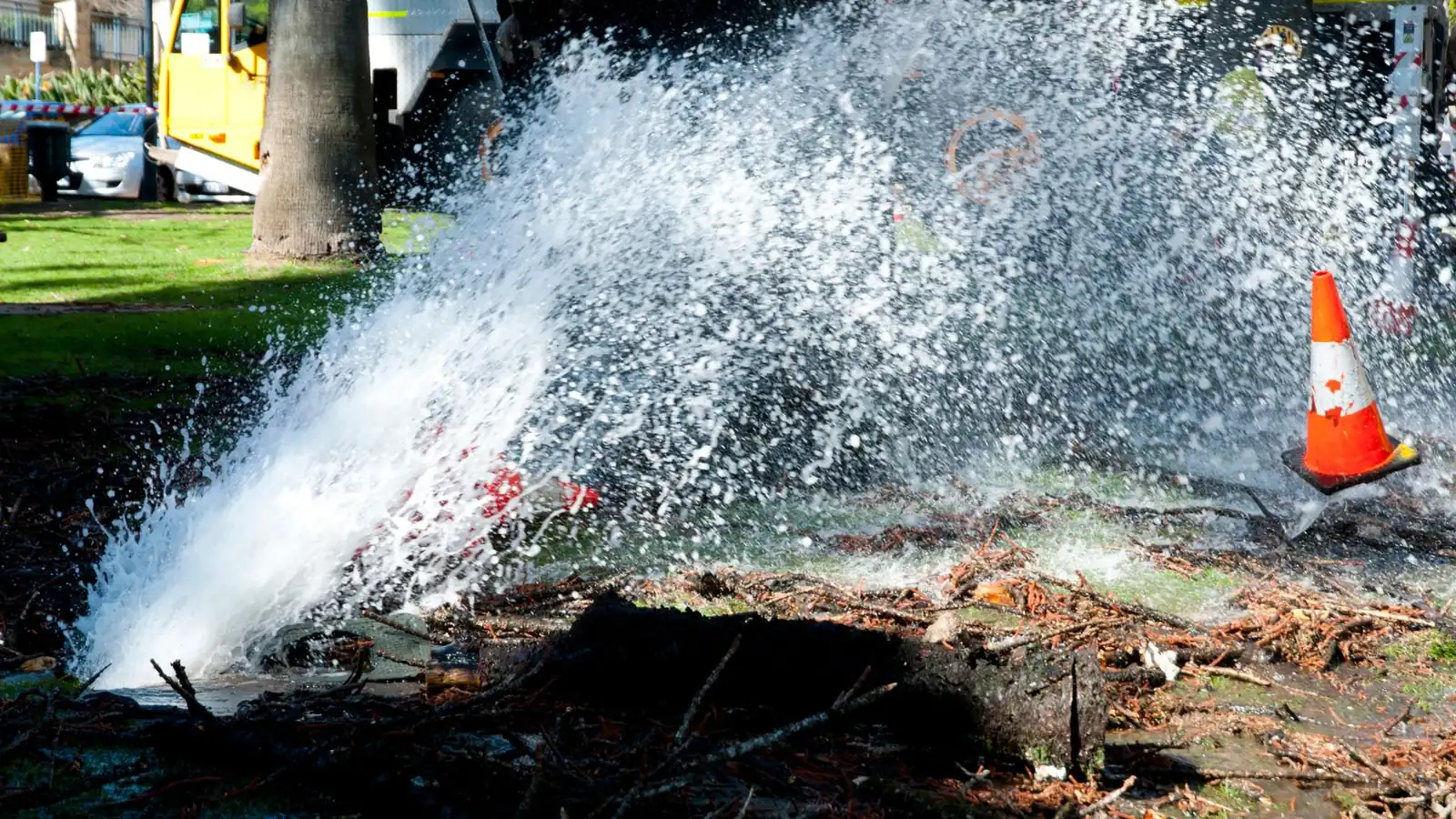
Seconds matter
A burst supply line can release gallons of water per minute. Every minute you spend searching for the shutoff is another minute of damage to floors, drywall and belongings. The best time to find the valve is today, not during the flood.
This guide shows the usual locations, the types of valves and what to do once the water is off. Then it explains what comes next, because shutting off the water is the start, not the end.
Where to look
The main shutoff is where the water line enters your house. In many homes that is in the basement or a utility room, near the water meter or the water heater. In houses without a basement it may be in a closet, garage or crawl space. Some homes also have an outdoor meter box near the street with its own valve.
- Basement wall facing the street.
- Utility room near the water heater.
- Crawl space or garage wall.
- Near the meter, often with a pipe running through the floor.
- Outdoor meter pit, with a lid that requires a special tool.
Three common valve types
| Valve | How it looks | How to close it |
|---|---|---|
| Gate valve. | A round handwheel. | Turn clockwise several full turns. |
| Ball valve. | A lever handle. | Turn the handle a quarter turn so it crosses the pipe. |
| Stop valve at a fixture. | A small oval or round handle. | Turn clockwise to close. |
Gate valves can stick or break if they have not been turned in years. Turn gently, and if it will not move, do not force it. Call a plumber and Village Public Works. A ball valve is easier to use and is a common upgrade a plumber can make.
Step by step when a pipe lets go
Close the main
Turn the main shutoff fully closed.
Open a low and a high faucet
Draining the lines lowers pressure and limits leaking.
Switch off power if needed
Turn off power to wet areas only if you can reach the panel dry.
Photograph the damage
Capture the source and water line before cleanup.
Call for help
Phone a restoration company and your insurer.
Our burst pipe water damage page explains what happens next, and water extraction describes how water is removed. If a heater is the source, see water heater leak cleanup.
Fixture valves: the small ones that save big
Toilets, sinks and washers each have their own shutoff. Closing a fixture valve stops one leak without shutting off the whole house. Check that each one turns, because valves that have never been used can seize. Replace braided washer hoses on a schedule, and keep an eye on the washer valves when you can see them.
If a valve drips or weeps at the stem, mention it to a plumber. A weeping valve is a small leak that can grow.
What the shutoff does not fix
Stopping the water prevents more damage, but it does not dry what is already wet. Carpet, drywall and subfloors keep absorbing water that is already inside. The faster you start drying, the better the odds. Structural drying explains how professionals remove hidden moisture.
The Illinois Department of Insurance says standard homeowners policies generally exclude flood, and many cover sudden plumbing events. Photograph first, mitigate next, and then ask your insurer how they want to handle the claim.
Label it and tell everyone
Tag the main shutoff with a bright label. Show every adult and older child in the house how it works. Keep a plumber and a restoration company in your phone. If you rent, ask the landlord where the valve is and write it down.
Residents of Hanover Park and Streamwood face the same pressure when a line goes, and the same label helps on any street.
Your side and the Village side
Roselle distributes Lake Michigan water supplied by the DuPage Water Commission. The Village owns the system up to a point, and your plumbing from the meter inward is your responsibility. If the break is outside, call Village Public Works at 474 Congress Circle North. If it is inside, close your main and call a plumber.
Water heater replacement and plumbing work need permits through Roselle Development and Engineering Services, so ask before upgrading a valve or heater.
Source types: Village of Roselle, DuPage Water Commission
Questions Roselle homeowners ask
Often in a basement, utility room or crawl space near where the line enters the house, or in a meter pit or box outside.
Do not force it with a pipe wrench. Try a few gentle turns, and call a plumber or the village if it will not move.
If a heater is leaking, close its cold water inlet. Turn off gas or power to the heater as well, following the manufacturer guidance.
The curb stop belongs to the water system, and you should call Village Public Works instead of operating it yourself.
Open a faucet at the lowest point and one at the highest. The flow should stop within moments.
Open faucets to drain lines, photograph the damage, and call a restoration company and your insurer.